Catacol and the meaning of the Twelve Apostles
A single terrace of white cottages gives Catacol its defining view, and its windows carry a local story about families, the sea and a changed home.
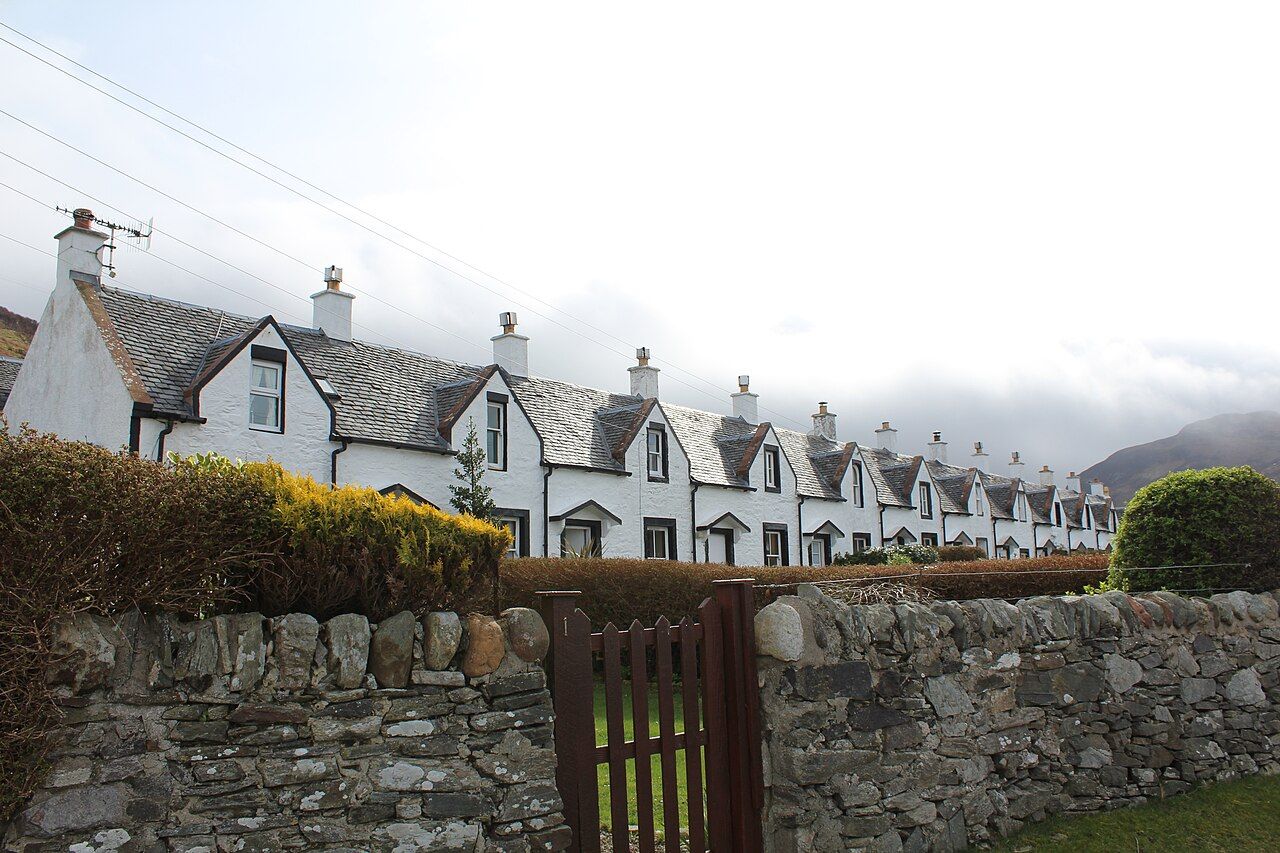
A row of twelve cottages presents an obvious temptation: count them, then look for what distinguishes one from another. At Catacol, the Twelve Apostles are not just a line of houses facing the sea. Their windows make the row less uniform than it first appears, and their history gives it a purpose beyond appearance. They are a modest but pointed record of families moved from the land.
What are the Twelve Apostles?
They are a terrace of twelve whitewashed cottages at Catacol, a hamlet on Arran’s north-west coast, about 3 km south-west of the village round the sea loch. Their position gives the row a clear presence without needing any grand architectural claim. The cottages face the sea, and the fact that they stand together is the thing to notice. There is little complication in the view: one terrace, one shoreline, and a sequence of houses that holds the eye.
Why were the cottages built?
The Twelve Apostles were built in the 1860s for families moved from the land in Glen Catacol. That history gives the terrace its weight. A row of cottages can look orderly, even settled; here, its beginning is tied to a change in where those families lived. The buildings are not a full account of that experience, but they keep the move in view. The row does not explain the circumstances, and it would be wrong to ask it to.
What is unusual about the windows?
Each cottage has an upstairs window of a different shape. The variation is small, but it keeps the terrace from reading as a repeated pattern. A local story says the windows let families signal to fishermen at sea. It is a good story because it gives the differences a purpose; it is also best kept as a story, rather than treated as settled explanation.
What does one row of houses stand for?
Not everything, and that is part of the point. The cottages cannot stand in for all that happened to families moved from Glen Catacol. They can, however, hold that history in view beside the sea. I prefer this kind of landmark to one that claims to explain a place: the row is specific, and its meaning should not be stretched beyond the facts. Its strength is in the particular detail of a shared terrace, not in making it a symbol for every story of displacement.

What lies behind the hamlet?
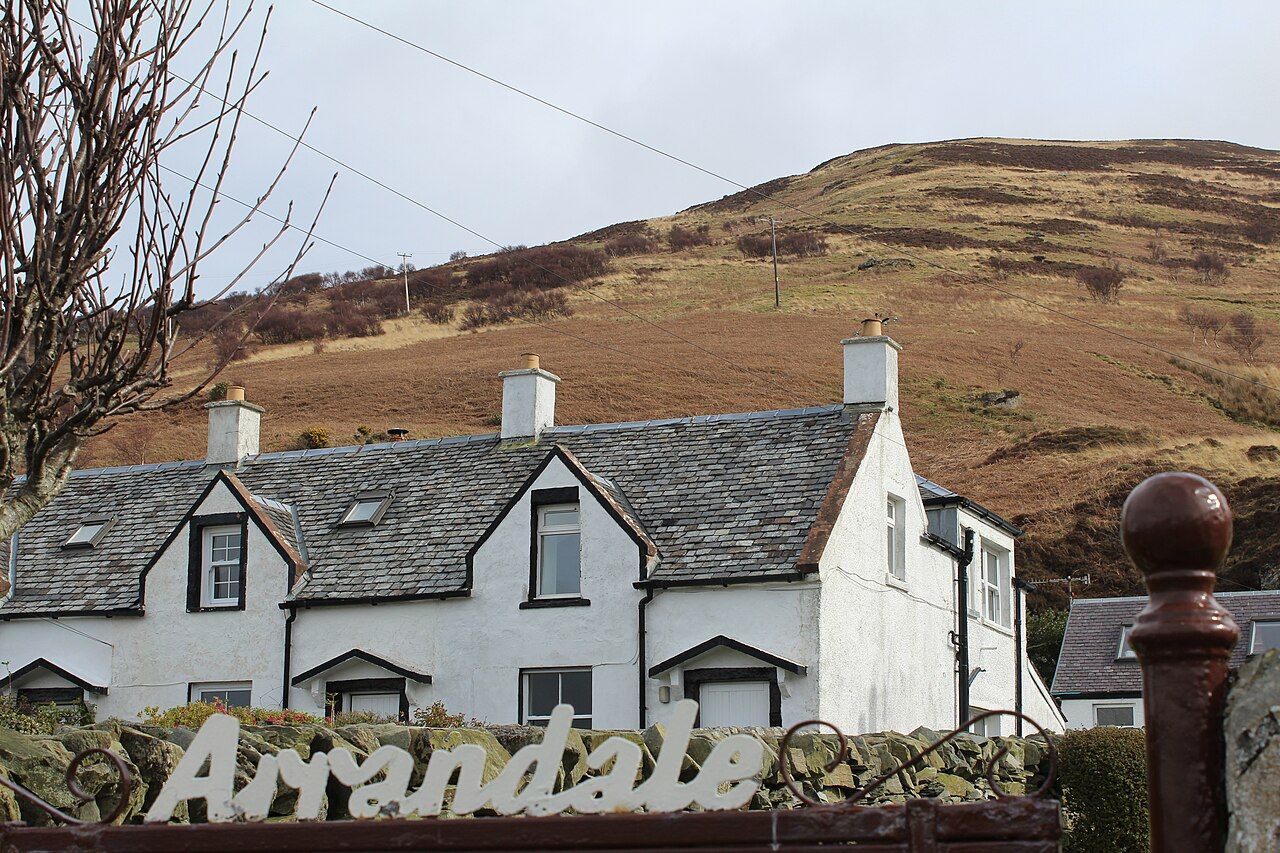
Glen Catacol runs south-east from the hamlet into the northern hills. At the head of its paths lies Loch Tanna, the largest freshwater loch on Arran. Glen Diomhan, a side glen of Glen Catacol, is home to rare whitebeam trees found nowhere else; the rare trees of the side glen give the landscape another kind of distinction, quieter than the terrace and less immediately legible. The houses and the glens make different kinds of impression: one close and made by people, the other shaped by the land.
What can be seen from Catacol Bay?
The bay faces west across Kilbrannan Sound to Kintyre. That broad view offers a different scale from the cottages: the terrace holds the eye close, while the water opens it out. The row remains the stronger reason to pause, though. It gives a human measure to a shore that could otherwise be read only as scenery.
Is the terrace the whole story of the north?
No. It is one small settlement, with hills, glens and the sea around it. The the deer of the northern hills belong to that wider setting, just as Catacol’s connection to the village round the sea loch places it among other northern places. But the Twelve Apostles make their own argument, cottage by cottage: a home can carry a history without explaining it away. The terrace is not a summary of Arran; its value is that it gives one local story a visible form.
What stays with me?
The difference between the windows, and the uncertainty in the signal story. The first is visible; the second leaves room for imagination without asking it to become proof. Catacol’s terrace is modest, but it is more than a pleasing line beside the water. The view reaches beyond the cottages, yet the row makes a persuasive case for looking back at the houses themselves. What else might those windows have meant to the families who lived behind them?