The King's Cave: an old shore and a Bruce legend
A sea-cut sandstone cave, old carvings and a familiar story about Robert the Bruce: the landform is the stronger claim, but the legend gives it another layer.
What makes the King's Cave worth asking about?
Is the King's Cave chiefly a legend, a set of carvings or a piece of coastline left behind by a higher sea? The fairest answer is that it is all three, though not in equal measure. The cave is the largest of a group in the sandstone cliffs on Arran's west coast, north of the village at the road's end. Its shape has a plain explanation: the sea cut it when the sea stood higher than it does today. That is the most solid part of the story, and the part that gives the place its particular interest.
The Bruce tale is more memorable, but less singular. The carvings add something harder to dismiss than a legend, while the cave itself remains the main event.
Why call it a cave on an old shoreline?
The King's Cave belongs to a coast that has changed level. The sea once stood higher; it cut into the sandstone cliffs and made the cave. The cave is therefore a mark of a former meeting between land and sea, rather than simply a gap in the cliff that happens to face the water.
That makes the old shoreline the cave sits on more than a useful phrase. It points to the reason the cave is here. The present coast and the cave's origin do not belong to quite the same arrangement of land and water. There is no need to dress that up. It is an unusually direct connection between a visible feature and the forces that formed it.
The story works best when that older coast stays in view. Otherwise the cave can become only a setting for the Bruce legend, which is a smaller way of looking at it.
Did Robert the Bruce shelter here?
A legend says that Robert the Bruce sheltered in the King's Cave in 1306. There, the story goes, he watched a spider try again and again to spin its web. It is a neat piece of storytelling: a cave, a fugitive king and an act of persistence small enough to make the setting feel close at hand.
But a good tale is not the same as a distinctive one. The same spider legend is told of several other caves in Scotland and Ireland. That repetition does not make the King's Cave unworthy of the association; it does mean the story cannot be treated as proof that this was the one place where the scene happened. The cave has a stronger claim through its geology than through the legend's ownership.

The Bruce story also brings to mind the castle linked with the Bruce, but the cave's own appeal does not depend on making the legend larger than the evidence given for it.
Is the legend the main reason to care about the cave?
The cave is more convincing as a piece of coast than as a stage for a legend.
The cave is more convincing as a piece of coast than as a stage for a legend.
That is not a dismissal. The legend gives a visitor a story to carry into the place, and the spider's repeated attempts are an image that fits the idea of shelter and endurance. It is simply worth keeping the proportions straight. This is a story told about the cave, not the only reason the cave matters.
The setting has its own explanation and its own evidence. Sea action shaped the rock; the cliff is sandstone; and the cave is the largest in its group. Those facts make a more lasting case than the familiar shape of the Bruce tale.
What do the carvings add?
The walls carry carvings that include crosses and other early figures. They give the cave another human layer, distinct from the legend of the king. The marks are part of the place itself, rather than a story that could be told of several caves.
There is no need to claim more than that. The available facts do not identify who made the carvings or explain what each figure means. Their presence is enough to change the way the cave reads: not just as a hollow made by the sea, but as a place where people have left marks on the stone.
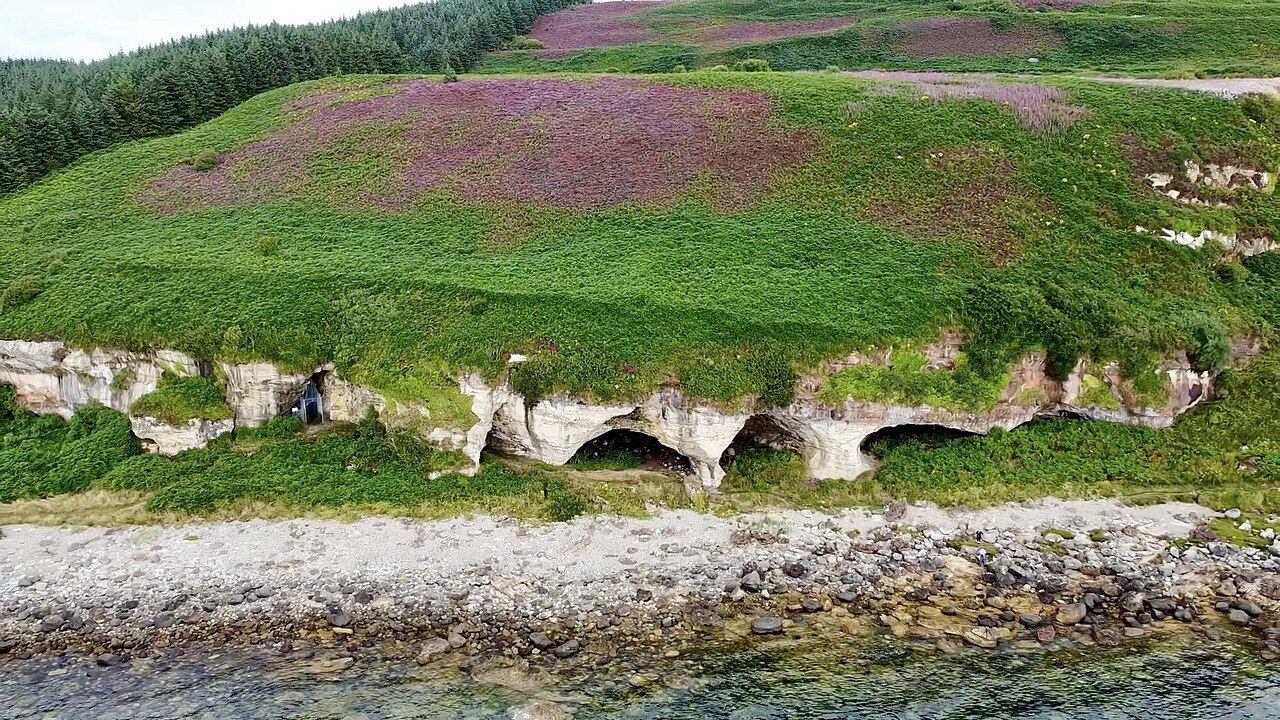

That combination is the King's Cave's real strength. The coastline explains its form; the carvings show human attention; the Bruce story supplies a tale, but one shared with other places. Each has a different weight.
What is the walk like?
A forest path and a shore path combine to make a circular walk to the King's Cave. The pairing suits the place. The cave sits in the sandstone cliffs, but it makes sense as part of a coast rather than as an isolated feature, and the walk brings those two kinds of setting together.
The entrance is closed by a gate with open bars. That is a detail worth including in any account of the cave: the entrance is visible, but it is not simply an unmarked opening. The walk and the cave belong to the experience, without needing to turn the place into a checklist of tasks.
What should stay in mind?
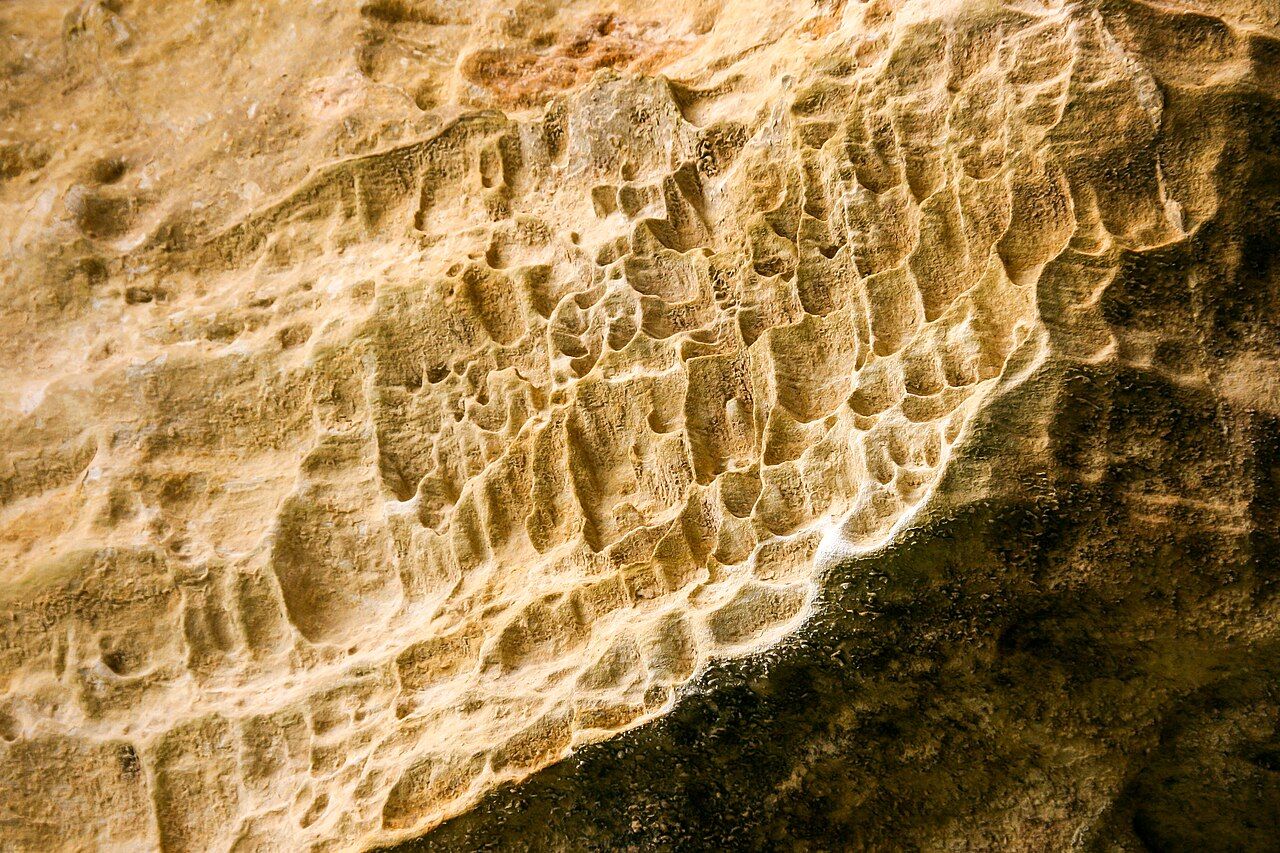
The cliffs around the King's Cave are red sandstone, weathering into honeycomb hollows. That surface gives the coast a character of its own, but it is not a reason to oversell the scene. The more useful observation is that the rock is still being shaped, in a way that echoes the sea's older work in cutting the cave.
The King's Cave is at its best considered in layers. First comes the old shoreline, the clearest explanation of the cave. Then the carvings, which leave human marks without settling their meaning. Last comes the Bruce legend, memorable but told elsewhere too. None cancels the others.
So is the King's Cave a place made more interesting by its legend, or a coastal feature whose story happens to have acquired a king and a spider?