Cir Mhor, the great comb
At the meeting of Glen Rosa and Glen Sannox, Cir Mhor is most persuasive as a single granite shape, with the Rosa Pinnacle adding a climber’s face.
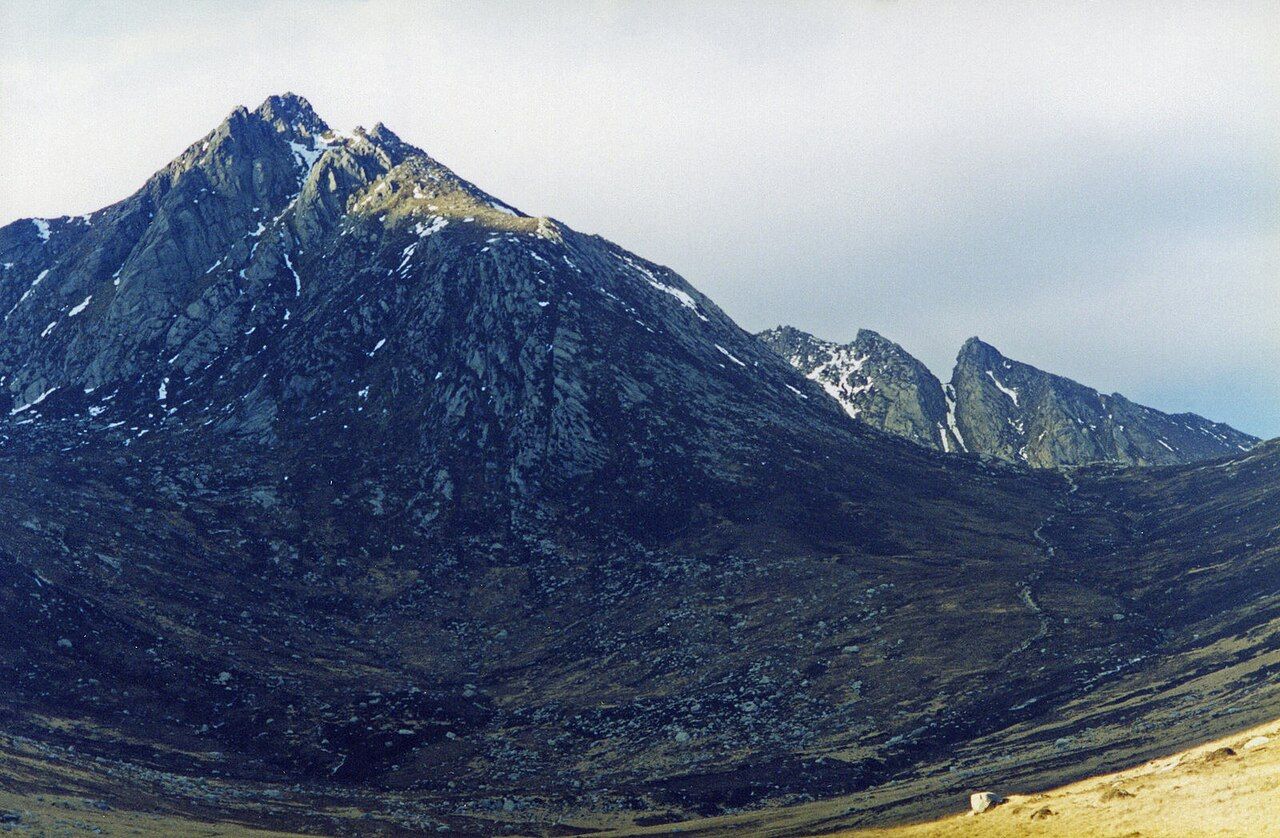
I tend to take Cir Mhor in as a shape before I think of it as a summit. From the String Road and from Brodick, its pointed outline is easy to pick out. That is the mountain’s strongest argument: it has a form that reads clearly, without needing a grander story attached to it.
Cir Mhor means “the great comb” in Gaelic. The name suits a granite peak of 799 m, standing where the heads of Glen Rosa and Glen Sannox meet. Those details place it firmly in the northern hills of Arran, but the outline does more than the geography to make it distinctive. It looks like one mountain, rather than a collection of features.
The granite is part of that impression. The peak is made of the rock the peak is made of, and its pointed shape gives the material a clear identity. The comparison is not abstract: the summit is a small rocky top, with steep drops on several sides. This is not a broad, forgiving crown. The shape comes with a sharper edge on the ground.
On the south face, the Rosa Pinnacle is a tall granite buttress. Its South Ridge is one of Arran’s best-known rock climbs, and this is where Cir Mhor’s appeal shifts from outline to climbing face. The peak is not only a striking profile from a distance; the rock has a recognised focus of its own. For a different line through the hills, there is the scrambling ridge to the south.
A path climbs to the summit from the Saddle. That gives the mountain a clear approach, but the summit itself remains a small, steep-sided place. It is a useful contrast with the higher summit across the Saddle: Cir Mhor’s case rests less on height than on its pointed form and the granite face beneath it.
That is enough. Cir Mhor is best taken on its own terms: a sharp, well-defined mountain where two glens meet, and a peak whose shape is its best feature.